
What Lapeer Deed Records Show
A deed conveys an interest in land. That sounds simple, but the recording system holds many other instruments too, including mortgages, discharges, liens, easements, and plats that touch the same parcel. None of those is a deed. The exact type and precise language of the document determine what it actually does.
| Deed type | What it generally does | Typical record question |
|---|---|---|
| Warranty deed | Conveys an interest with stated title covenants | Was a standard transfer recorded? |
| Quitclaim deed | Conveys whatever interest the grantor holds | Was an interest released or reorganized? |
| Fiduciary deed | Conveys through an authorized representative | Did an estate or trust transfer land? |
| Sheriff or foreclosure instrument | Records a transfer linked to legal process | What instrument followed the proceeding? |
| Tax-related deed | Records a conveyance tied to tax process | Did the tax matter reach transfer? |
The recorded text always controls. Table labels are reading aids only, never conclusions about a specific Lapeer County title.
Lapeer Register of Deeds
The Lapeer County Register of Deeds administers real-property instruments as public records. Register Amy R. Stearns's office sits at 287 W. Nepessing St., Suite 1, Lapeer, Michigan 48446. The phone number is 810-667-0211, and published weekday hours run 8:00 a.m. to 4:30 p.m.
The county page connects visitors to LandWeb, recording details, transfer-tax resources, fees, forms, directions, and Simplifile e-recording. E-recording is simply an intake path for authorized submissions. It is not a public title search, and it cannot replace obtaining a recorded copy.
Lapeer County Register of Deeds
287 W. Nepessing St., Suite 1
Lapeer, MI 48446
810-667-0211
LandWeb Access Has Limits
The official county page points to LandWeb. That route has returned an HTTP or security response rather than a usable interface, so its current field labels, document filters, image availability, prices, and earliest online coverage remain unconfirmed. The blocked screen itself is not evidence about the records behind it.
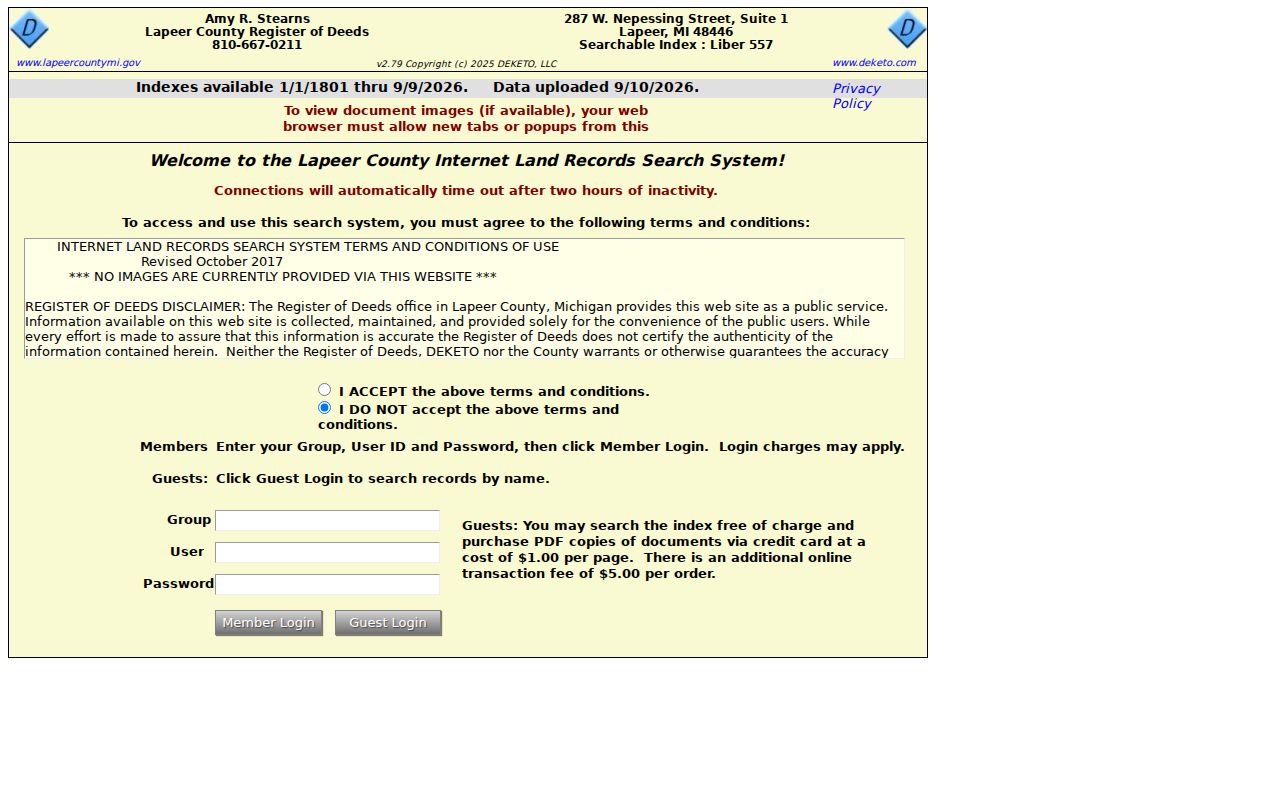
An access screen is not proof that deed records are missing. Try again through a normal browser session. Or ask the Register of Deeds to locate an instrument and explain the available copy options.
Portal gap: No verified earliest online year is available from the research, so older-chain statements must use archival sources without assigning them to LandWeb.
Walk Lapeer Deeds Backward
A chain of title is the ordered sequence of conveyances for one piece of land. Start with the newest deed you can confirm, not a guessed historic name. The grantee receives the stated interest, while the grantor transfers it.
- Locate the parcel ID, legal description, current owner lead, or newest recording reference.
- Find the latest conveyance and record its instrument type, date, and number or book/page.
- Read its grantor, grantee, and legal description.
- Search the current grantor as a grantee to locate that party's acquisition.
- Repeat while checking descriptions, parcel splits, easements, trusts, estates, and company-name variants.
- Take any gap to the Register of Deeds, deed books, or a professional title search.
Note: Search fiduciary capacities and middle initials, since the same party may be indexed under several forms.
- Grantor
- The party transferring the stated interest.
- Grantee
- The party receiving that interest.
- Chain of title
- The linked sequence of recorded transfers.
- Instrument number
- A unique recording reference.
- Book and page
- An older volume-and-page recording reference.
Match the Lapeer Land
Names alone will not carry a search. Two people can share a name. One owner can also hold title through a trust or entity. At every step, compare the legal description and municipality. Check the parcel ID when shown, the instrument date, and adjoining references too. Remember that a split or combination can change the modern PIN. The older deed trail stays fully intact.
Platted land may carry subdivision, lot, and block references. Rural parcels often rely on section-based or metes-and-bounds descriptions. A plat maps recorded lots; an easement grants a stated use or access right. Neither should ever be reduced to a street address.
For a map-based starting point, use the Lapeer County parcel map. Then return to the recorded description before concluding that two instruments cover the same land.
Mortgages, Liens, and Releases
Deed records answer transfer questions. But a fuller review of recorded instruments also checks mortgages, assignments, discharges, liens, releases, easements, and plats. A mortgage is an encumbrance tied to a loan. A discharge or release may show that a recorded claim was later cleared.
Never assume an old indexed lien is still enforceable just because its first filing appears. Look for later releases and related instruments. A delinquent-tax entry, likewise, is an administrative lead. It is not proof that a foreclosure transfer finished. The County Treasurer confirms delinquent-tax status, while the recorder confirms a deed.
Lapeer Fraud Alert Monitoring
The county offers a Fraud Alert enrollment path tied to recorded names. The signup material warns users to enroll personal and trust-name variants. It also notes that confirmation arrives within two business days. Name selection therefore matters a great deal.
Lapeer County Fraud Alert instructions provide the current enrollment source. The service is monitoring, not prevention. It does not block a document or validate a signature. It does not insure title or prove an instrument is fraudulent.
Note: An alert should prompt review of the actual instrument. Contact the Register of Deeds directly.
Older Lapeer Deed Research
The LandWeb cutoff does not define the age of county land records. Historical collections reach much farther back. The Archives of Michigan guide identifies Lapeer tax rolls from 1839 through 1880. It also lists a Rural Property Inventory covering 1936 through 1942. These sources place land and its occupants in context, though they are not a modern title opinion.
The Lapeer District Library genealogy collection holds plat maps, atlases, newspapers on microfilm, directories, cemetery records, and family-history tools. A plat or newspaper notice may explain a subdivision name, estate event, road name, or farm reference missing from the current parcel card. The detail can matter.
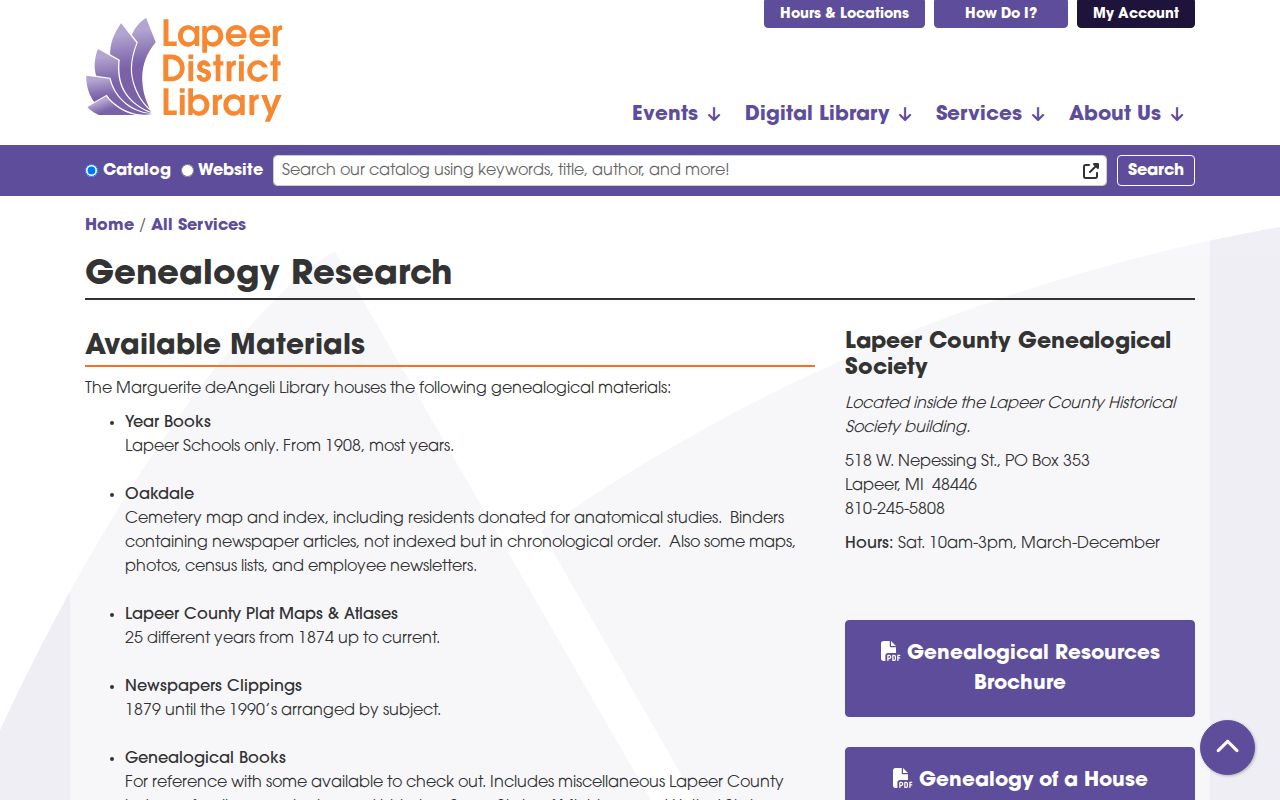
The library's collection bridges current deeds and local history. Confirm every historical lead against the deed books and the legal description.
Request a Lapeer Deed Copy
Give the Register of Deeds enough detail to pull a single instrument. Party names, the document type, and the recording date all narrow the search. A recording number or book and page helps. A parcel number or legal description also helps. Decide whether a plain or certified copy fits your purpose. Fees are not published here, so ask the office for the current price before ordering.
Several routes lead to the same Lapeer County deed records. A plain browser session may open LandWeb when an automated request fails. The counter works best for an image, an older volume, or a stubborn index mismatch. Telephone requests are another option. Confirm mail service with the office. Ask about current certification requirements.
Recorded, not guaranteed. The Lapeer County deed index reports instruments accepted for recording. It is not a title opinion, and unrecorded interests or defects may exist.
Deeds and Probate Transfers
An estate can interrupt a clean seller-to-buyer pattern in Lapeer County deed records. Probate orders, affidavits, personal-representative deeds, trust documents, and survivorship language may each explain a change in the chain. A name may appear for one transfer. It may then vanish from later Lapeer County property records. For the probate file itself, the Lapeer County Probate Court is the right office. The Register of Deeds still records the land instrument.
Match the court lead to a recorded document. A case index is not the transfer. Keep the case number, order date, deed recording reference, and legal description together. Note each in your records.
Build a Defensible Deed Chain
A defensible chain names its source for every link. Record the instrument reference, each party's capacity, and the legal description. Flag gaps rather than filling them with assumptions. Assessor and map data can help identify the parcel. The deed chain itself must follow recorded instruments only.
To trace earlier owners, continue with the Lapeer County former owners search. For address, owner, and parcel-number mechanics, use the property lookup. When ownership matters for a transaction or dispute, order official copies and get qualified title advice.