
Read the Core Lapeer County Property Tax Fields
Several different values fill Lapeer County property tax records, and each has its own job. The local assessor sets the parcel assessment and its classification. County Equalization then studies uniformity across local units. The Treasurer handles delinquent taxes and foreclosure administration. FetchGIS and the county BS&A page surface many of these fields quickly. Still, when a field is disputed, the office responsible for it remains the authority. The portal that displays it is not.
| Field | What It Shows | Where |
|---|---|---|
| Assessed value | The assessor's value before equalization, generally targeted at half of true cash value | Local assessment roll |
| Final SEV | Assessed value after county and state equalization | FetchGIS or BS&A |
| Final taxable value | The tax base after Proposal A limits and applicable changes | Assessment and tax record |
| PRE or exemption | Tax treatment recorded for the parcel, not proof of occupancy or title | Local assessor |
| Bill or delinquency | Tax-year charges, payment status, interest, fees, or delinquent balance | Local treasurer or County Treasurer |
Recorded consideration on a deed sits in a separate column entirely. It may describe a transaction, but it is not automatically true cash value. It is never the same thing as taxable value. For help interpreting the values themselves, see the Lapeer County property value guide.
Match BS&A to the Lapeer County Tax Year
The Lapeer County BS&A landing page offers separate routes for assessing and current-tax searches. It also covers delinquent-tax and detailed-record searches. Address, owner name, and parcel number all work as entry points. Some direct result pages require a live session or a security step. Start at the municipality page each time rather than saving a temporary results URL.
| Search input | Best use | Check before relying |
|---|---|---|
| Address | Locate a familiar property | Municipality and exact street match |
| Owner name | Find parcels billed under a known name | Name variants and mailing-address differences |
| Parcel number | Carry the same account across portals | Preserve letters, zeroes, and hyphens |
The county portal page displays its service tiles and search entry, not any individual parcel result.
Open the official BS&A source shown below.
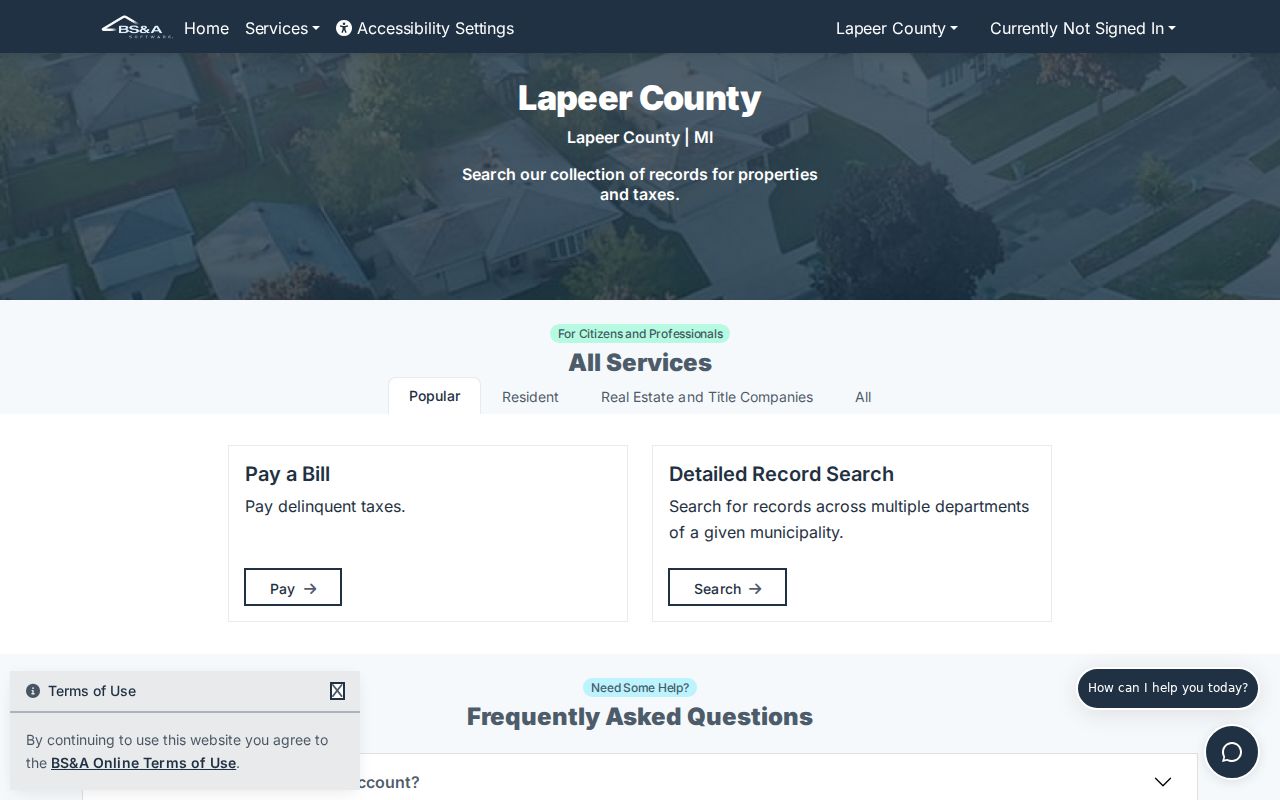
Label every copied figure with the tax year and local unit shown. A portal tile is an access point, not an assessment decision.
Why a Lapeer County Taxable Value Can Lag
Michigan's true-cash-value framework generally targets assessed value at half of true cash value. SEV follows equalization. Taxable value works differently. Proposal A limits its annual change until a transfer of ownership uncaps it. New construction and parcel splits can pull the figures apart too. So can exemption changes and classification corrections.
Call this the false triangle of Lapeer County tax records. Assessed value, SEV, taxable value, and recorded consideration can all be correct while remaining unequal. A family transfer makes a sale figure especially weak as a market comparison for the parcel. So can a foreclosure, a partial-interest conveyance, or a sale that includes personal property.
Note: Record the tax year, property class, and exemption status beside every Lapeer County value comparison.
Check Lapeer County Delinquent Property Tax Status
Once local taxes go delinquent, the Lapeer County Treasurer's delinquent-tax page is the right status source. It explains parcel-number and address research, payment channels, and a drop box. Published payment costs include a 3 percent credit-card fee and a $3 e-check fee. A current payoff can still shift with interest, fees, corrections, or a recent payment. The county page keeps search and payment routes together. That makes checking delinquent Lapeer County property tax records much easier.
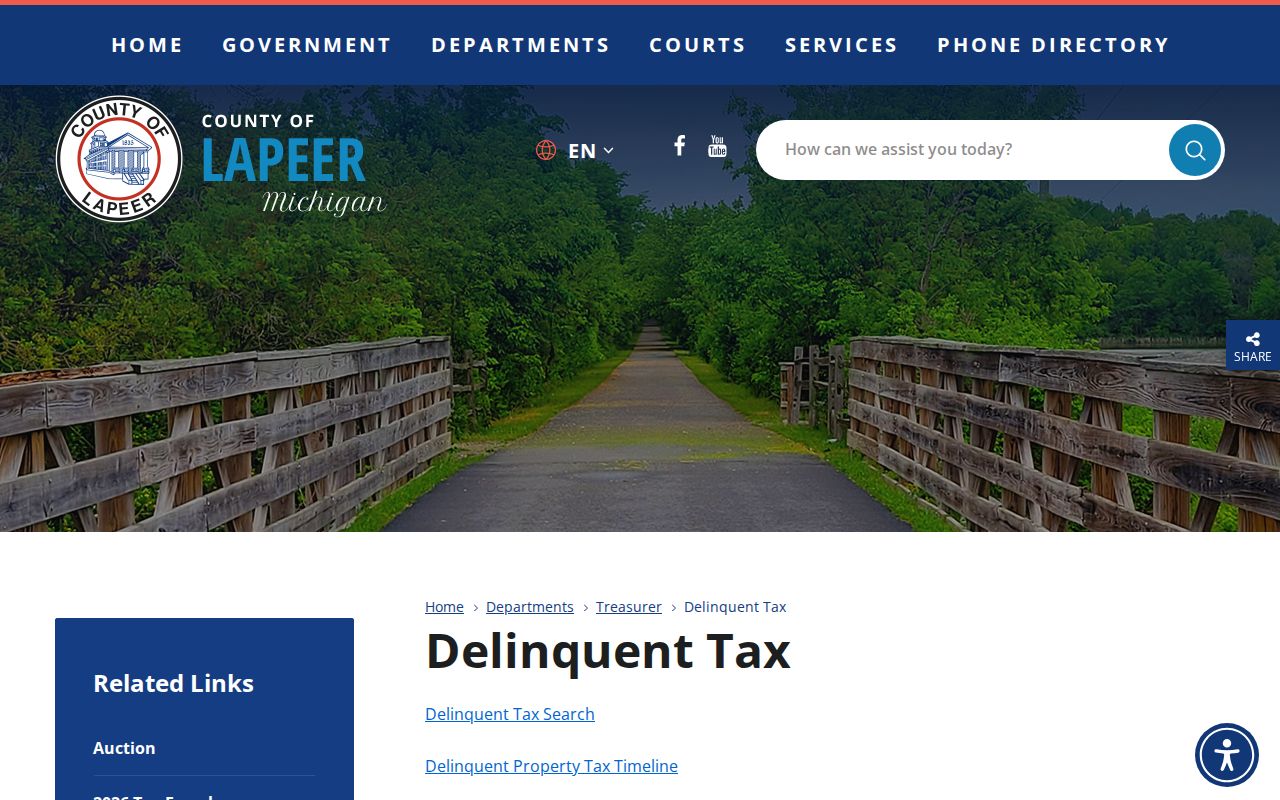
Before paying or calling an account delinquent, confirm the parcel, tax year, and live balance with the Treasurer.
A Tax Auction Listing Does Not Transfer Title
The Treasurer's forms and resources page posts foreclosure-auction notices, a hardship form, and commercial and industrial deferral material. It also offers property-information resources. A dated notice marks a step in the tax process. It does not establish present ownership. Later payment, redemption, court action, sale results, and recording can all change the outcome. The county page gives that status research a time-stamped starting point.
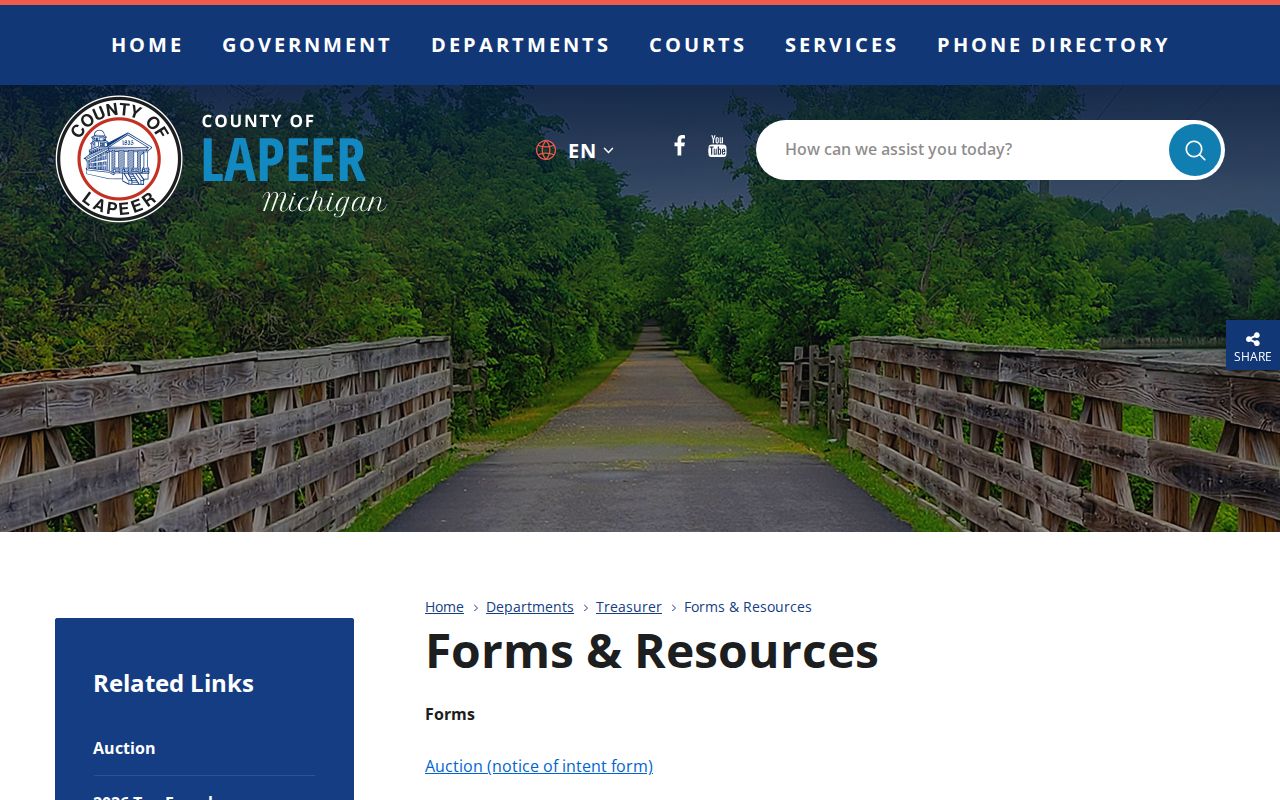
After an auction or foreclosure event, verify any claimed title change through the Lapeer County deed records route rather than treating a listing as a deed.
Trace a Lapeer County Property Tax Bill
Trace the account from parcel identity to the current taxing office. Then separate the assessment from the payment history.
- Locate the parcel by address in BS&A or FetchGIS, then copy the PIN exactly.
- Read assessed value, Final SEV, Final Taxable, class, and PRE or exemption for the same tax year.
- Open the local current-tax account, or use the County Treasurer for delinquent years, and record bill and payment status separately.
- If foreclosure or auction language appears, save the dated notice and ask the Treasurer for the current stage.
- Assessed value
- The assessor's valuation before equalization, not the tax base or a sale appraisal.
- Millage or levy
- The rates applied by the relevant taxing units to the taxable base.
- PRE or exemption
- A recorded tax treatment that can change the bill; eligibility must be confirmed officially.
- Tax lien
- A claim arising from unpaid tax, distinct from a completed foreclosure or recorded ownership transfer.
When the Lapeer County Tax Portal Is Not Enough
Online Lapeer County property records are only one access channel. A field-level discrepancy belongs with the local assessor who maintains the parcel roll. County Equalization explains equalization and classification context. But it does not replace the local assessment decision. The Treasurer answers delinquency, payoff, foreclosure, and payment-status questions on the tax roll.
Ask for a parcel-specific record by PIN, address, tax year, and field. Say whether the request concerns assessed value or SEV. It may also concern taxable value, class, PRE, special assessment, bill, payment, or delinquency. When a public document is not available online, the county FOIA process accepts a sufficiently described request. It may charge authorized costs.
A portal result may lack history. It may omit the reason for a correction. A mailed or in-person request often works better then. Ask the assessor for the assessment card and roll status. Also ask for the basis for any classification or taxable-value change. Ask the Treasurer for public account status and the applicable year. Also ask for the notice stage and payment or redemption details. These are separate questions for separate custodians of Lapeer County property records.
Keep the observation and response dates. Recording intake, assessment-roll updates, tax-year rollover, and payment posting all follow different schedules. No official Lapeer County source promises a deed-to-roll synchronization interval.
Challenge a Lapeer County Property Assessment
An appeal starts at the local level. The assessor sends a notice each year, and that document holds the numbers worth questioning. Michigan's Board of Review page is the official source for the L-4400 Notice of Assessment, Taxable Valuation and Property Classification. It also carries the L-4035 petition and the L-4035a taxable-value worksheet. The same page includes poverty-exemption material and State Tax Commission guidance.
Gather evidence before filing anything. A strong case includes the correct year and the classification. Add parcel attributes and comparable sales that truly match. Any transfer, split, exemption, or recent improvement can explain a change, so document it. Pull current forms from the state page rather than relying on an old deadline.
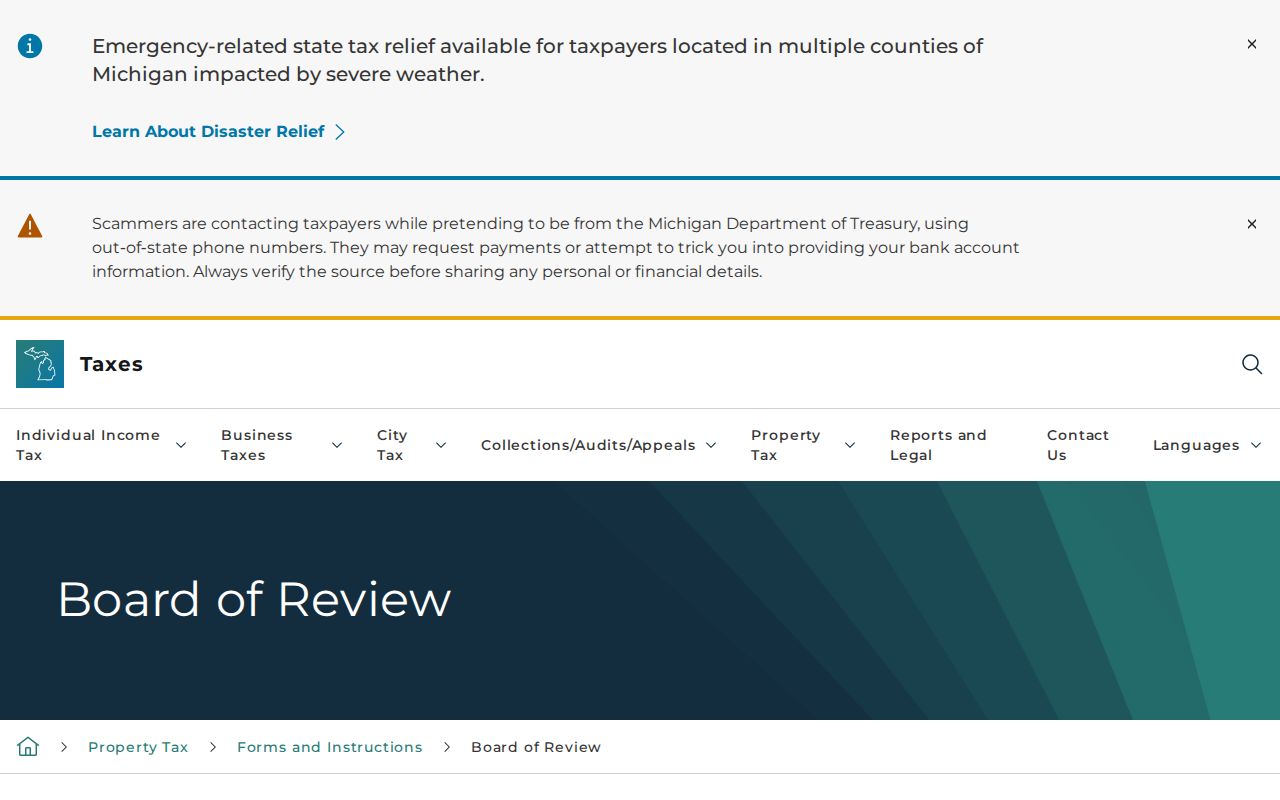
Dates matter enormously here. Filing windows and later tribunal deadlines shift with the year and the property classification. Read the current notice and instructions closely.
Evidence carries an appeal. Start with the basics. List the assessment year, class, acreage, building area, year built, and any new construction. Comparable sales persuade only when dates, classes, physical characteristics, and transaction conditions line up meaningfully. For a taxable-value dispute, add transfer history, exemption records, and the taxable-value worksheet.
The 2024 State Tax Commission bulletin shows why no calendar can be generalized. It sent assessment and classification issues through the March Board of Review. Later tribunal deadlines then differed by property category. Treat those dates as historical examples, not a schedule for a later year.
Use the current deadline. Assessment and classification issues generally begin with the March Board of Review, but the exact schedule comes from the local notice and current state guidance.